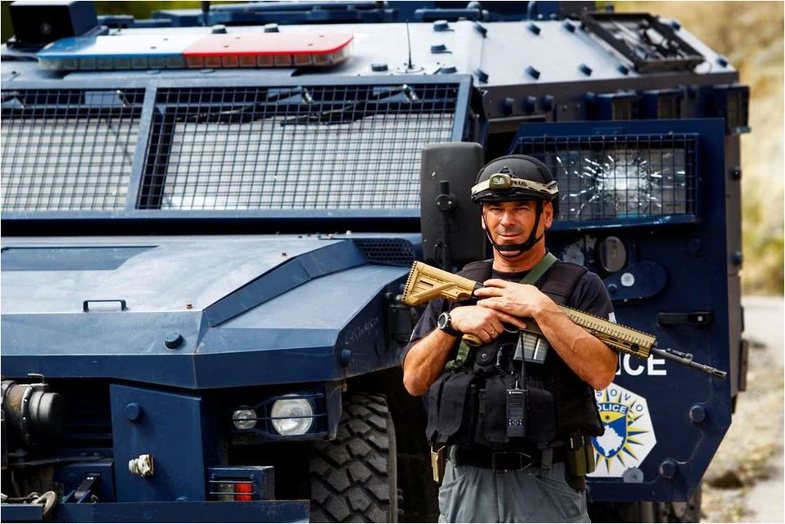
The White House said there is an "unprecedented" build-up of Serbian troops and armor along the border with Kosovo and called on Belgrade to withdraw them immediately.
NATO's peacekeeping force in Kosovo, KFOR, has been reinforced with British troops, and the Biden administration said it was consulting with allies to ensure that KFOR's posture "matches the threat".
"We are monitoring a large Serbian military deployment along the border with Kosovo that includes an unprecedented deployment of advanced Serbian artillery, tanks and mechanized infantry units," a spokesman for the US National Security Council said on Friday. John Kirby.
"This is a very destabilizing development that has taken place over the past week and we are calling on Serbia to withdraw its forces from the border and reduce tensions."
The National Security Adviser, Jake Sullivan, called the Prime Minister of Kosovo, Albin Kurti, to discuss the escalation of the situation, and the Secretary of State, Antony Blinken, spoke with the Serbian President, Aleksandar Vucic, and called for the reduction of tensions and the normalization of relations with Kosovo.
The US warnings come at the end of a tense week that began with an armed Serb group ambushing a Kosovo police patrol in which one policeman was killed. In the ensuing battle, near the village of Banjska, three Serb gunmen were killed.
The armed group was led by Milan Radoicic, the vice president of Lista Serbe, a Belgrade-backed party that represents the Serb minority in northern Kosovo. Through a lawyer, Radoicic said he was responsible for the exchange of fire with Kosovo police, but did not explain the source of the modern weapons.
The Kosovo government released a document showing that a grenade launcher the group had been carrying had been given to them by the Serbian army, and officials in Pristina expressed concern that Sunday's clash was intended to serve as a pretext for Serbian military intervention in northern Kosovo.
Sources: Guardian, Reuters