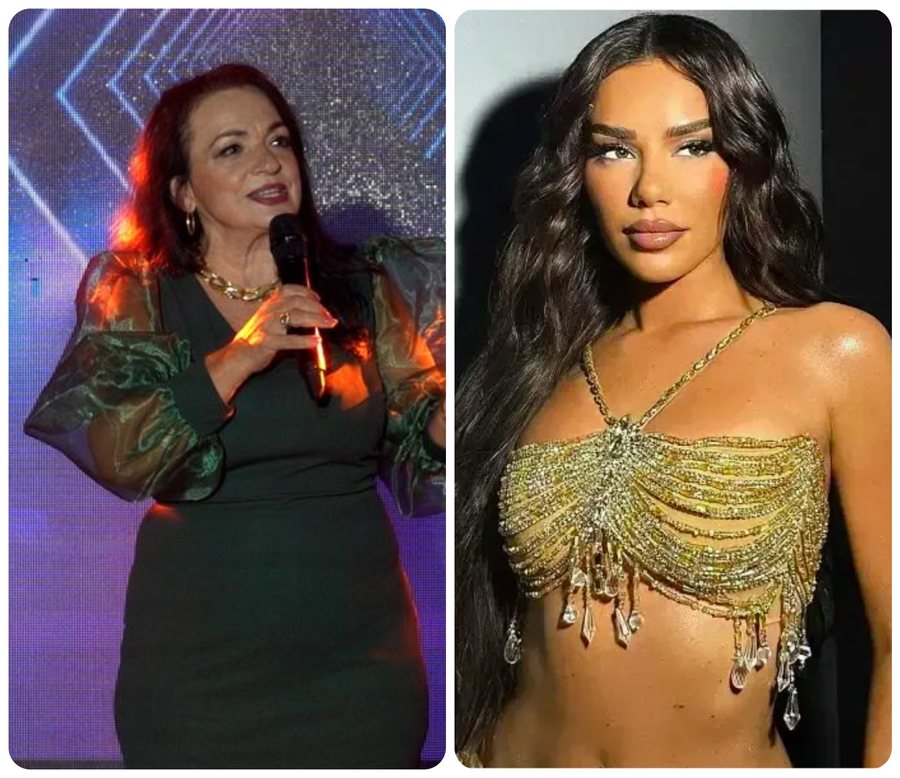
Following statements made by singer Alida Hisku on the show "Mes'dritë" on Vizion Plus, regarding the use of her voice in Tayna's "Thana" project, the issue has received widespread public attention and raised questions about the legal aspect of the agreement and financial compensation.
Given that the statements directly touched on issues of copyright, contractual authorizations and payments, Anabel Media officially contacted the management of Doruntina Shala (Tayna) to request more information about the use of the song “Vajzat e fshatit tim”, a song composed by Enver Shëngjergjin, lyrics by Zhuliana Jorganxhi and performed by Alida Hisku.
Below, we are publishing the full and unchanged statement sent by the artist's manager, Rina Malsori.
"Hello,
I am addressing you as the manager of Doruntina Shala (Tayna) regarding the recent reports and statements made by Alida Hisku regarding the "Thana" project.
For professional correctness and to avoid any misinformation, I am presenting the facts:
The copyright for the verse “Ana e pas ana o, lumit të fshati tim” has been acquired by regular contract with Enver Shëngjergji, as the party that granted the authorization. The beneficial party is Doruntina Shala (Tayna).
The contract is signed and the payment has been made in the total amount of €1,500, according to the request and agreement of the party itself:
– €1,000 for rights
– €250 for each of the relevant parties
So we have a regular agreement, with documentation and full financial compensation.
The song "Thana" is an original creation with:
– Composer/Producer: Mixey
– Lyrics & interpretation: Doruntina Shala (Tayna)
The beat and musical production are the property of producer Mixey, according to standard music industry rules. The composer himself has been clear that the other party has no claims on the beat, as it is the producer's creation.
Also, Ms. Alida Hisku in another interview stated that the song "was given to us", which is in complete contradiction with the current claims. These contradictions highlighted in the statements create public confusion and unfairly damage the artist's reputation.
Regarding the financial aspect: the price of a professional beat in the current market and their demand for this 10% of the song is significantly higher. However, we have fully respected the amount requested by the other party, without negotiation and without dispute, precisely out of respect for her age, artistic contribution and image. The payment was made as requested by them.
So:
– The rights were obtained by contract.
– The payment was made at their request.
– The beat is the property of the producer according to industry rules.
– The public statements are contradictory.
Given that there is clear documentation and financial evidence, any reporting that suggests otherwise directly damages the reputation of Tayna and her team.
If false publications or insinuations that damage the artist's image continue, we will be forced to take legal steps to protect her reputation and for defamation.
We are not looking for public controversy. We are only looking for fair and fact-based reporting.
If verification is needed, we are ready to present the relevant documentation.
Thank you for your professionalism!”
Tayna's team has made the relevant agreement and payment documentation available to Anabel, which has been viewed and verified by the editorial staff.
Meanwhile, to more clearly understand the financial aspect and market practice for using samples or verses from existing songs, Anabel also consulted with an expert in the field of copyright, who preferred to remain anonymous.
According to him, in copyright there is no "minimum price" or basic fee for the use of a piece of music. The payment depends on several essential factors:
– How desirable is the part being taken (how well known or identifiable it is)
– How famous is the giving party
– How famous is the using party
– How is the part being used (length and role within the new song)
– Concrete negotiations between the parties
Even in European markets, where there are stronger institutions for copyright protection, there are no fixed prices for such cases. A deal can be 0 euros, if the parties agree to authorization without financial compensation, but it can also reach hundreds or thousands of euros, depending on the reputation and commercial potential of the project.
The expert added that in the Balkans, especially for the use of older songs, it often happens that there is no payment at all, which is also related to the lack of information or legal ignorance of the earlier artists. In cases where there is a payment, for partial uses of a song, the amounts usually range from 400 to 1,000 euros in general.
"In copyright there is no minimum price - there is only authorization and what is agreed upon between the parties," he emphasized.