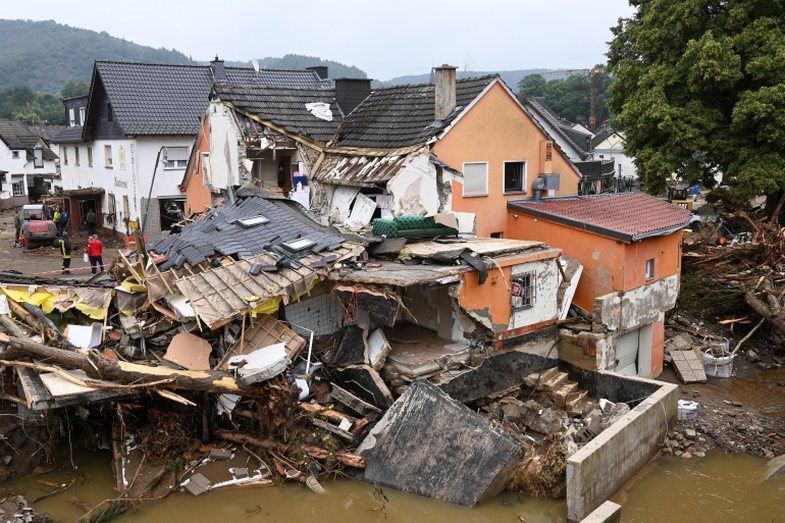
The death toll in devastating floods in West Germany and Belgium has risen to at least 170, as of Saturday, after rivers and major floods erupted this week where houses collapsed and roads and power lines were destroyed.
About 143 people lost their lives in the flood that was described as "Germany's worst natural disaster in more than half a century". Hundreds of people are still missing, as some areas have remained inaccessible due to high water levels. Residents and business owners have tried to save some pieces, from the destroyed places.
"Everything is completely destroyed. The place is no longer known," said Michael Lang, owner of a wine shop in the town of Bad Neuenahr-Ahrëeiler in Ahrweiler, as he tried to hold back tears.
German President Frank-Walter Steinmeier visited Erftstadt in the state of North Rhine-Westphalia, where the disaster killed at least 45 people.
"We are with those who have lost friends, acquaintances, family," he said. "Their fate is breaking our hearts."
About 700 residents were evacuated late Friday after a dam broke in the town of Wassenberg near Cologne, authorities said. However, Wassenberg Mayor Marcel Maurer said water levels "have stabilized since that night".
"It's too early for clear data, but we are optimistic and cautious."
The Steinbachtal Dam in West Germany, however, remains in danger after the evacuation of about 4,500 people. Steinmeier said it would take weeks before the full damage, which is expected to require several billion euros in reconstruction funds, could be estimated.
In Belgium, the death toll rose to 27, according to the national crisis center, which is co-ordinating the relief operation there. The center added that 103 people were "missing or inaccessible". Some were certainly inaccessible because they could not recharge their cell phones or were in the hospital without identification tools.
During these days, floods, which have mainly hit the German states of Rhineland Palatinate and North Rhine-Westphalia and eastern Belgium, have cut off entire communities from energy and communications.
RWE (RWEG.DE), Germany's largest power producer, said on Saturday that its Inden open mine and the Weisweiler coal-fired power plant were massively affected, adding that the plant was operating at a lower capacity as the situation was stabilized somewhat.
In the southern Belgian provinces of Luxembourg and Namur, authorities rushed to supply drinking water to families. Belgian railway network operator Infrabel has announced plans to repair the lines, some of which would return to service only in late August.
During these days, politicians are visiting damaged areas and trying to launch financial recovery plans.
Alarm also in the Netherlands
Emergency services in the Netherlands also remained on high alert as overflowing rivers threatened towns and villages across the southern province of Limburg.
Tens of thousands of residents in the region have been evacuated in the past two days as soldiers, firefighters and volunteers worked hard on Friday night to enforce the ambushes and prevent flooding.
The Dutch have so far survived the disaster and no casualties have been reported so far.
Scientists have long said that climate change will lead to greater rainfall. But determining its role in these relentless rains will take at least a few weeks to be explored.
Luxembourg and Switzerland
Luxembourg and Switzerland were also hit by torrential rain and warnings were issued in some regions.
Earlier this week, Britain was hit by major floods that "plunged parts of London into deep water and turned residential roads into flowing rivers".
Source: Washington Post, Reuters