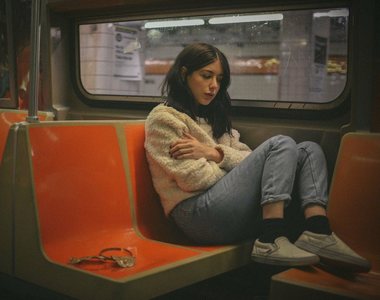
Erjola Doçi had an explosion inside the house of "BBVA 3", where she claimed to see shadows. Crying and obviously scared, Erjola turned to Julian Deda, saying: "Always, Juli, something must happen to me. Even yesterday I gave my hand to Ervin to sing me a surah. They blackened my life. Even at night I saw shadows. Who the hell does these things God will repay! It happened to me, you don't know what I went through, because I didn't share it with people", claiming that there are people who practice black magic on him.
She then went on to say that the same thing has been happening to her for years. "I don't get obsessed, this conversation has been going on for years. Even at night... I don't get obsessed, because I went and was seen in a good place. I suffered from that part, I used to have marks on my body".
Starting from Erjola's event, but also from a high number of followers who shared their strange stories with jinn and ghosts (which you can find on Anabel's account) on Instagram, we asked the experts in the field. We contacted several psychologists, who shared their thoughts about this widespread phenomenon.
Clinical psychologist, Arjona Marra, said: "There are many emotional disorders that also have psychosis as a symptom. Psychosis, unlike neurosis, is characterized by a severe difficulty in distinguishing reality from imagination. People can go through different psychotic episodes, for various reasons", adding that psychotic episodes are often also the main companions of disorders such as psychotic depression or schizophrenia.
"Often seeing or hearing unreal things can be associated with certain forms of severe anxiety. Considering that anxiety at its root is the irrational fear of things that could potentially happen, many people in difficult emotional conditions can feel that these events have happened and can happen. This is a false mechanism of our nervous system, unprepared for what is happening. Most of the time, seeing unreal things that people, due to lack of information, call "spirits" or "ghosts" are actually auditory or visual hallucinations related to the above conditions.
We also communicated with clinical psychologist Erjona Berdica, who said:
"I think Erjola had a panic attack, or an anxiety attack. Although without having information from Erjola herself, or about her feelings, I cannot give an accurate opinion, or prove something through the video, since it is not possible to make a complete clinical picture of her condition. I think that the psychologist who supervises the emotional and mental health of the residents should do several sessions to understand more about the situation in which she is", emphasizing that Erjola needs professional help.
Psychologist Tea Brokaj explained to us why this phenomenon is so common in our country.
She said that superstitions are an ingrained factor that comes to the surface through childhood traumas and at some point, shadows and paranormal activities are considered real.
"I think that here in Albania, superstitions are an ingrained factor and over time they surface through childhood traumas. Social myths, religious teachings, and folklore contribute to the creation of a shared reality where shadows and demons can be perceived as real entities. From childhood, we have grown up in toxic environments, where "scary" stories and personal experiences have been the topic of conversation at every table."
She added: "Human nature tends to commit and believe more about the fear of the unknown, not realizing that in this way the subconscious is manifesting events that do not exist, suppressed in fear and paranoia."
"Judging from my perspective, I think that the interpretation of ghosts, demons, and abstract figures, embodied by our own beliefs, are shaped by a complex interaction of cognitive processes, personal beliefs, and cultural influences. One of the most widespread phenomena through which people often think they see paranormal phenomena is "pareidolia", which sends alarming signals to the nervous system, thinking and feeling the situation as if it were real.
"Also, psychological conditions such as sleep paralysis and severe emotional states can play a very important role, creating vivid and sometimes disturbing hallucinations. These same cultural contexts often channel us into explaining unknown or frightening experiences, leading individuals to attribute them to supernatural causes," she concluded.